This week, the AI landscape shifted again. We’re not talking about minor updates but fundamental changes to how we interact with video, code, and even our own phones.
From OpenAI’s quiet release of GPT-5.2 to Alibaba’s stunning new video motion controls, here is your complete intelligence briefing on the tools redefining the bleeding edge.
1. The New Frontier: OpenAI Releases GPT-5.2
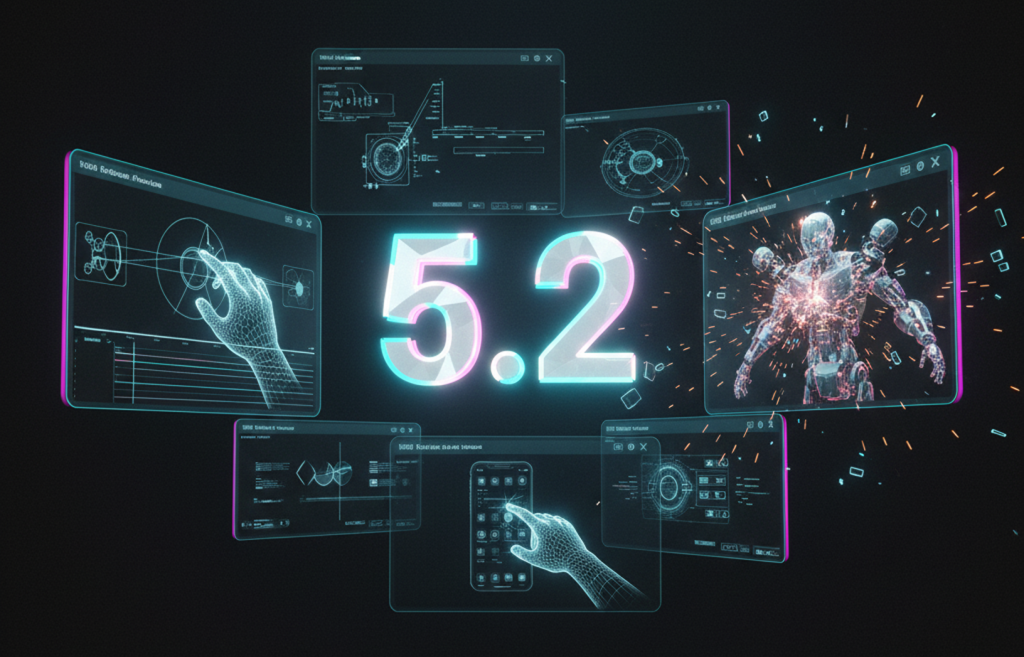
OpenAI just dropped GPT-5.2, specifically optimized for professional knowledge work.
- The Stats: It achieves near 100% accuracy on deep document analysis tasks (needle-in-a-haystack retrieval) across context windows up to 256k tokens.
- The Benchmark: In the new “GDPval” benchmark testing real-world work tasks across 44 occupations, GPT-5.2 (both Pro and Thinking models) consistently beats expert-level humans more than 50% of the time.
- Availability: Currently rolling out to paid users (Plus, Pro, Enterprise).
2. Alibaba’s “Wan-Move”: Precise Video Motion Control
Generating video is one thing; controlling it is another. Alibaba’s new Wan-Move allows you to direct AI video generation by drawing simple trajectories on a starting frame.
- How it works: You upload an image, draw an arrow, and the AI animates the object following that exact path.
- Capability: It handles single objects, multiple objects simultaneously, and even camera movements (pan, zoom, dolly) with shocking consistency.
- Status: The code is open-sourced, and a ComfyUI wrapper is already available.
3. WindowSeat: AI That Erases Reflections
Taking photos through glass (planes, trains, windows) always results in ugly reflections. WindowSeat is a new AI model that removes them entirely.
- Performance: It outperforms all previous methods (like DSIT and RDNet) in restoring the original image fidelity behind the glass.
- Availability: The GitHub repo is live for local installation.
4. RealGen: Photorealism Solved?
RealGen introduces a “Detector Reward” mechanism during training, forcing the model to recognize and fix “AI artifacts” (like plastic skin or weird lighting) before outputting the image.
- The Result: Images that are nearly indistinguishable from photography, complete with natural film grain and motion blur.
- Open Source: Yes. The code and training protocols are available on GitHub.
5. TwinFlow: 1-Step Image Generation
Speed is the new battleground. TwinFlow can generate high-quality images in one single step, compared to the 20-50 steps required by traditional diffusion models.
- Speed: It generates 4 images in ~5.2 seconds on consumer hardware, vs. 120+ seconds for comparable models like Qwen-Image.
- Efficiency: It achieves this without sacrificing quality, making it ideal for real-time applications.
6. Open-AutoGLM: The AI That Uses Your Phone
Zhipu AI released Open-AutoGLM, an agent capable of navigating your smartphone’s GUI to complete tasks.
- Capabilities: It can search for coffee shops on Maps, find products on shopping apps, add them to your cart, and navigate checkout sequences autonomously.
- The Tech: It’s a 9B parameter model that fits on consumer GPUs (and potentially high-end phones in the near future).
7. MoCA: Modular 3D Generation
MoCA generates complex 3D assets from a single image but with a twist: it separates the object into meaningful, editable parts.
- Utility: Instead of one solid mesh, you get a “robot” with separate arms, legs, and head, making it instantly ready for rigging and animation.
8. StereoWorld: 3D Video from 2D Clips
StereoWorld converts standard 2D video into stereoscopic 3D (left/right eye) footage with depth perception.
- Innovation: It uses a massive dataset of 11 million video frames to learn how to infer depth and reconstruct scenes for VR/AR viewing.
9. Snapchat’s EgoEdit: Real-Time Reality Editing
This is AR on steroids. EgoEdit allows you to edit video streams in real-time using text prompts.
- Examples: Change a computer mouse into a banana, turn a water fountain into lava, or clean up a messy desk—live, as you film it.
10. One-To-All: Consistent Character Animation
Finally, One-To-All solves the “flickering” issue in AI video. It takes a character reference and a motion reference (pose skeleton) and generates a smooth, consistent animation.
- Stability: Unlike Wan-Animate, which often warps limbs, One-To-All maintains character identity and structural integrity even during complex dance moves.