Most design workflows are bloated. You have the ideation phase, the drafting phase, the vectorizing, the mockups, and finally, the photography. It is a slow, expensive grind.
Nano Banana Pro claims to collapse this timeline. While the general public uses generative AI for surrealist art or memes, the real utility lies in commercial synthesis. We put the model through a stress test: building “Verdant,” a fictional high-end matcha brand, completely from scratch. No inventory. No photographers. No assets.
Here is the operational breakdown of how AI is rewriting the branding playbook.
1. The Typography Benchmark
Text rendering has historically been the Achilles’ heel of image generation models. You ask for a logo; you get alien hieroglyphics.
Nano Banana Pro appears to have solved this variable. We prompted for an “elegant ‘V’ vector logo in sage green,” and the output was precise. A clean, sans-serif font on a cream background. It didn’t hallucinate extra lines. It didn’t warp the geometry. This suggests a model that actually understands typography as a design element, not just a texture.
2. Material Physics and Product Visualization
A logo is easy. Rendering aluminum and condensation is hard.
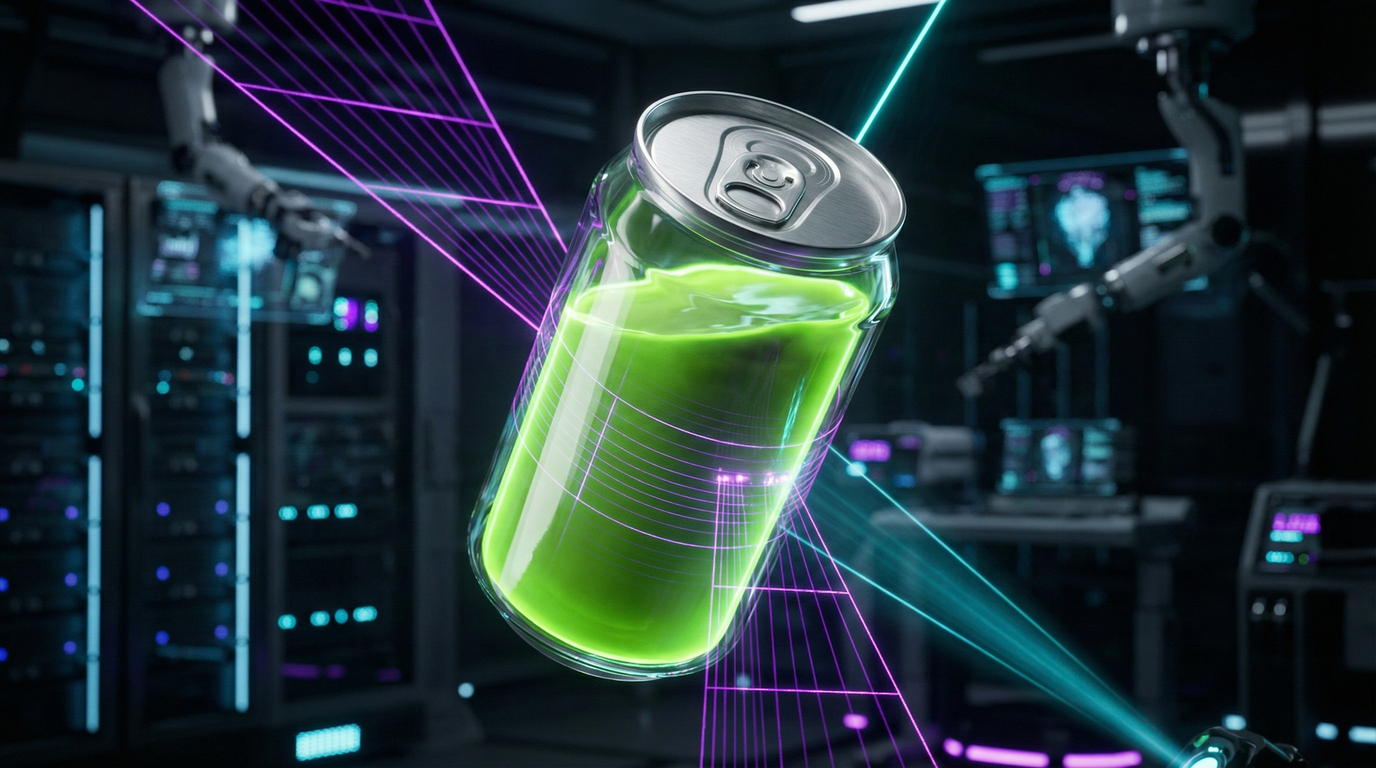
We moved to product packaging: a slim, transparent can with an aluminum top. The model didn’t just place a sticker on a cylinder. It rendered physics.
- Transparency: You can see the liquid density.
- Texture: Condensation droplets were placed logically, adhering to surface tension rules.
- Lighting: The reflection on the aluminum top matched the ambient light source.
When we shifted the liquid color to a “blue matcha with deep purple streaks,” the model handled the fluid dynamics impressively. It looked intermixed, not just layered. This level of fidelity usually requires a senior 3D artist and a render farm.
3. Contextual Injection
A product on a white background is sterile. It needs to live in the world.
We placed the “Verdant” can in high-difficulty environments:
- The Cafe Shot: Marble table, open silver MacBook, dappled sunlight. The AI generated a coherent screen on the laptop without specific prompting. That is a detail most models miss.
- The Porsche Console: Leather interior, harsh sunlight. The shadows aligned perfectly with the window position.
- The Lifestyle Fit: A woman walking on a promenade holding the can. The hand placement—often a nightmare in AI generation—looked natural.
The model understands ambient occlusion. It knows that an object placed on a table casts a shadow that anchors it to reality. Without that, images look like bad Photoshop.
4. Expanding the Asset Library
A brand isn’t just a product. It’s a vibe. It’s merchandise.
We scaled the experiment to generate a full suite of branded assets:
- Merch: Hoodies and tote bags with the logo correctly warped around fabric folds.
- Pop-up Architecture: A wooden stand with greenery and textile banners.
- Social Proof: An Instagram grid layout that maintained aesthetic consistency across nine different tiles.
The ability to generate a “screenshot” of an Instagram feed where the model replicates the UI and populates the content with on-brand imagery is a significant workflow accelerator. It allows creative directors to visualize the “end state” of a marketing campaign before a single product is manufactured.
The Verdict
We went from a text prompt to a full brand identity—including lore, mascots, and web design—in under an hour.
This isn’t just about speed. It’s about the democratization of high-fidelity aesthetics. Nano Banana Pro demonstrates that the barrier to entry for luxury branding is no longer capital; it is imagination.